Who protects your money? Every P2P trade needs an answer. Exchanges hold your funds — and freeze them at will. Middlemen hold your funds — trustworthy right up until the day they run. InVeil protects funds with code: everything locks inside a smart contract that even the protocol's owner cannot touch. That is decided by the code itself — your money's safety depends on no institution, and on no one's human nature.
The exchange way
Protection by custody.
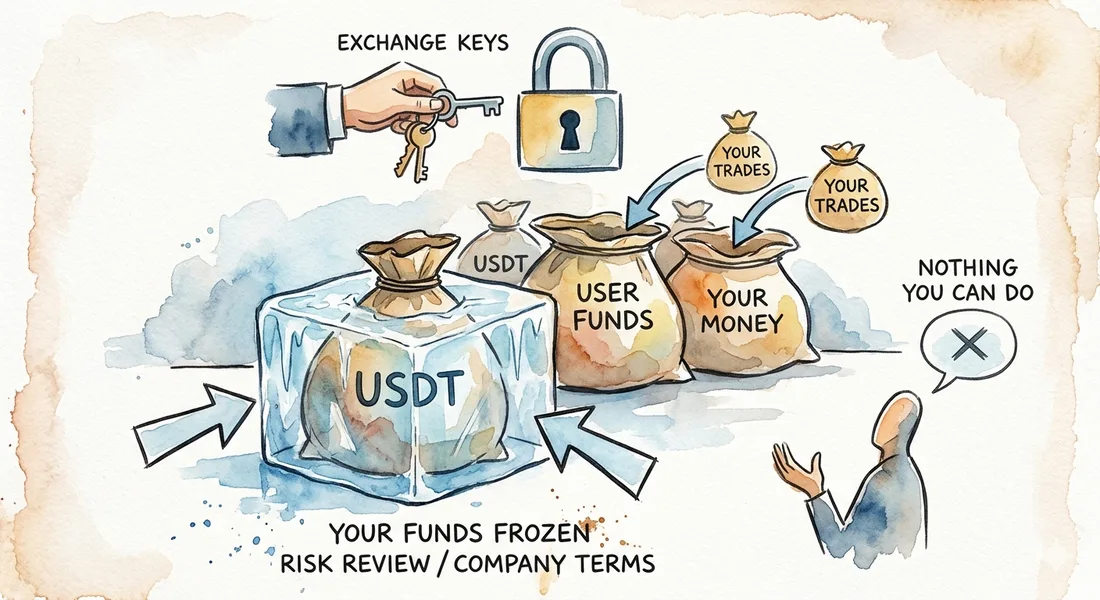
They can freeze your funds — at any time.
A centralized exchange protects your trade by taking your money first. Your USDT sits in the company's wallets, under the company's keys, governed by the company's terms. The fatal flaw: they can freeze your funds at will — "risk review", "third-party payment", any reason will do. A freeze costs them exactly one sentence, and there is nothing you can do about it.
The middleman way
Protection by reputation.
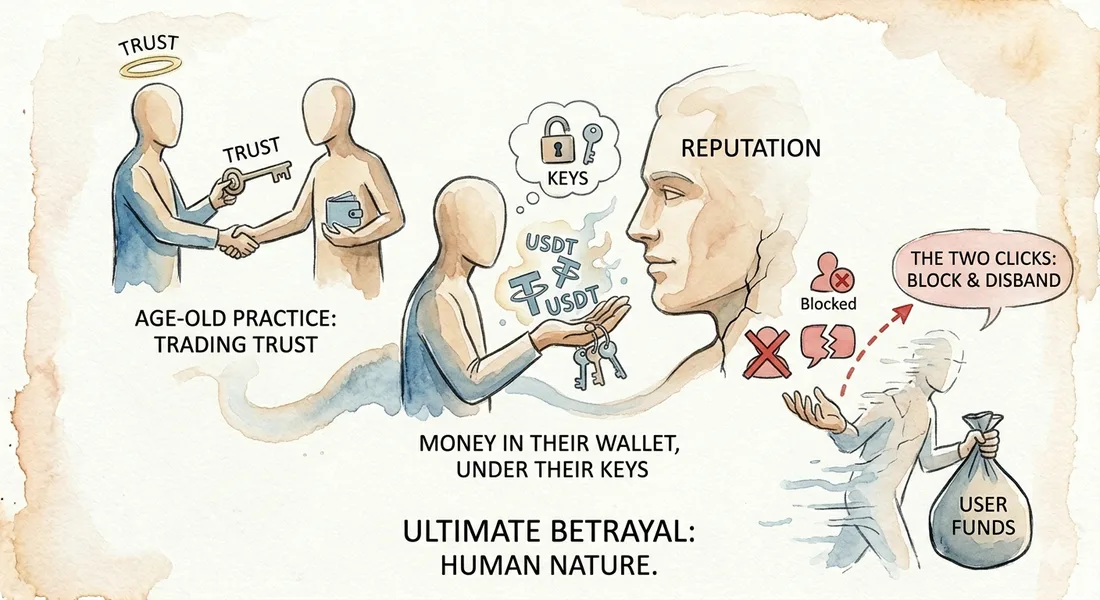
They can run at any time — block you, disband the group, vanish.
Over-the-counter (OTC) middlemen use their reputation to protect your trades — an age-old practice. The stranger you trust today will still be trustworthy next week, next month — until the day they completely disappear. And disappearing takes them exactly two clicks: block you on Telegram, disband the group chat. Your money sits in their wallet, no different from their own; they don't need to freeze anything — running away is the most cost-effective option. Trust human nature, and human nature will ultimately betray you.
The InVeil way
Protection by code.
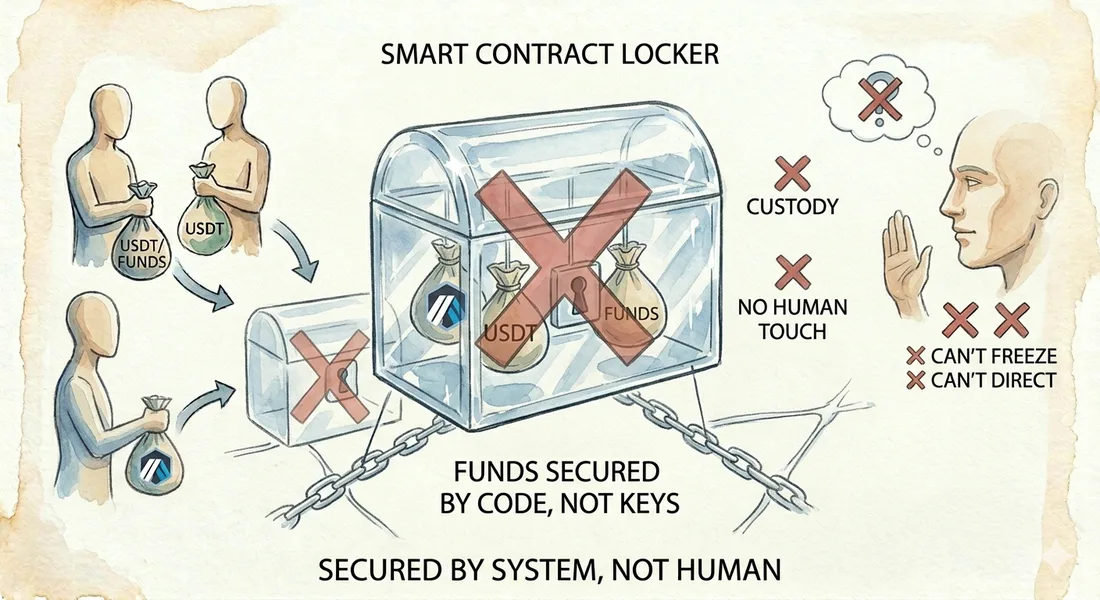
No one can freeze it. No one can run with it.
InVeil gives custody to no one. Both sides' funds lock inside a smart contract on Arbitrum — open code whose release rules are fixed per trade and enforced by the chain itself. We can't freeze your balance, can't run away, can't touch the escrow at all — and neither can anyone else.
Verify it yourself.
Don't take our word for any of it. These contracts are the entire system — live on Arbitrum One, source verified on Arbiscan.
Verified Contracts
Arbitrum One (mainnet)State machine
Fund custody
Arbitration
Account & access
Registries
All contracts are live and verified on Arbitrum One. EscrowLogic and ArbitrationCommittee are resolved live from LogicRegistry.
Every line of this code is open source. Read it, test it, attack it, or hand it to anyone you trust — every kind of inspection is welcome.
Protected by Code.
Not Promises.
No sign-up. No KYC. No middleman.